Stevens Family Farm 1-888-783-2545
FAQs

- What is Flaxseed?
- What are the health benefits of Flaxseed in your diet?
- Why Grind your own Flax Seed?
- How do I take Flax Seed and get the most benefits?
- What is the difference between Brown Flax and Golden Flaxseed?
- How long will Flax Seed store?
- Why buy from us?
- Who we will I be talking to when placing my order?
- Any Guarantee?
- Does this Flaxseed work for Pillows?
- I want more information. How do I get the answers?
- How do we ship?
What is Flaxseed?
Historically, flaxseed has been used for food and feed for animals for several thousand years in Europe, Asia and Africa, and more recently in Canada and the United States. Oil pressed from flax seed also has been a basic cooking oil in China and other countries for centuries.
So-called LINSEED OIL pressed from flaxseed is an "industrial" oil that is used for paints, coatings, linoleum, and many other products. Linseed oil is pressed and further extracted from flax seed with a petroleum solvent. Industrial linseed oil is not useable for food or feed, although the linseed oil meal remaining after linseed oil extraction is used for animal, principally dairy, feed.
Fiber in the stem of flax plants is used for producing linen sheets, napkins, table cloths and clothing, and for FINE PAPERS, like bible paper, other parchment paper, and cigarette paper. The early pioneers to North America brought flax with them for linen production. Flax production moved westward, at first for linen production and later as a seed crop for linseed oil production. Competition from cotton, synthetic fibers and, cheaper vegetable oils and petroleum substitutes reduced the need to produce flaxseed for linseed oil or fiber.
Flaxseed is now produced primarily in North Dakota in the United States. Flax acreage is increasing in recent years because of increased use for food, and feed for PETS, SHOW ANIMALS, and other COMPANION ANIMALS.
Flaxseed in vegetarian diets is a good source of essential fatty acids, protein, carbohydrates, the phytochemical LIGNAN, potassium and other nutrients.
back to topWhat are the health benefits of Flax Seed in your diet?
FLAX SEED IS A RICH SOURCE OF OMEGA 3 FATTY ACIDS AND LIGNANS.
FLAX SEED HEALTH BENEFITS Ground flax seed is a source of Alpha-linolenic acid (ALA) and lignans that exhibit a number of properties that are essential to good health.
Alpha-linolenic acid (ALA) is both an essential fatty acid and an omega-3 fatty acid that can aid in:
- Regulating cholesterol, triglycerides and blood pressure.
- Controlling immune and inflammatory disorders.
Lignans are plant substances that, when ingested, are broken down in the digestive system into two main lignans, enterodiol and enteolactone. These lignans circulate thru the liver and are subsequently excreted in the urine. Lignans are thought to bind to estrogen receptors in the body and reduce the risk of hormonally related cancers. Flax seed is the richest know source of lignans.
Ground Flax Seed is also rich in protein, B vitamins, vitamin E, beta-carotene, calcium, potassium, magnesium, manganese and zinc. The fiber benefits of flax seed can only be found in the ground flax seed.
Typical ground flax seed intake: 25 to 30 grams/day Flax Seed Nutritional Data
Note: For optimum nutrient value, use ground flax seeds instead of flax oil. Flax oil contains omega-3 fatty acids, but it does NOT contain the beneficial lignans and fiber. The lignans and fiber are removed in the production process to increase shelf life.
back to topWhy Grind your own Flax Seed?
The answer is quite simple. In this day of processed foods, by grinding your own Golden Flax Seed from Stevens' Sales, LLC you know exactly what you are consuming.
Our Natural Golden Flax Seed is fresh from the farm and is NOT genetically modified. (AKA: GMO)
back to topHow do I take Flax Seed and get the most benefits?
- We recommend grinding your own flax daily to ensure freshness.
- Dosage: Take 2 to 4 tablespoons, ground, daily (start with 2 and work up to 4 tablespoons)
- Sprinkle ground flax on cereal, yogurt, or salads.
- Mix flax into meatloaf or meatballs.
- Add ground flax to pancake, muffin, cookie batter, or baked goods such as pie crust.
- Coat fish or homemade chicken nuggets in ground flaxseed and oven fry.
- Tip for cooking with Flax Seed: If you grind 1/4 cup of whole Flaxseed it will equal approximately 1/2 cup of ground Flax.
Browse some of our great flax recipes.
back to topWhat is the difference between Brown Flax and Golden Flaxseed?
There is not much difference between Brown and Golden Flaxseed other than Golden Flax Seed has more of a nutty taste. Nutritionally they are very similar. Our Natural Golden Flax and Roasted Golden Flax have the same nutritional value.
back to topHow long will Flax Seed store?
Flax Seed in the whole seed form will store easily for over two years. It does not need to be refrigerated or frozen, just store it in a food storage container out of the sunlight. Once the Flaxseed is ground it should be refrigerated or frozen.
Our Roasted Flaxseed (in the whole seed form) is shipped in vacuum sealed bags. Once the bags are opened the Roasted Flax Seed should be refrigerated or frozen to ensure freshness and quality. The Golden Roasted Flax has a guaranteed shelf life of 1 year.
back to topWhy buy from us?
What makes us different from the rest?
Quality Omega Golden Flax Seed. Honesty. Great Customer Support
- We raise our own flax seed.
- No middleman - You purchase direct from Stevens Farm
- We treat our customers the way we like to be treated.
- Our flax in non GMO.
- Our flax is fresh
- Our flax seed has not been sitting in a warehouse or store shelves for several months or years (the Omega Golden Flax Seed we market is from our farm's most current production).
- We are not a large corporation or pretend to be one (we are a true family farm).
- We are normally available to answer your questions in person, not a automated message system.
Our Omega Golden Flaxseed is cleaned and graded for human consumption. We strive to provide only the plumpest Flax Seeds giving our customers a very uniform product.
When you place your order you are talking directly to the people that raise the Golden Flax from planting, harvest, processing, packaging, ordering, & yes even shipping. There are only a few marketing Flax on the web that are actually involved in production agriculture.
See what our customers have to say about our Flax Seed
back to topWho will I be talking to when placing my order?
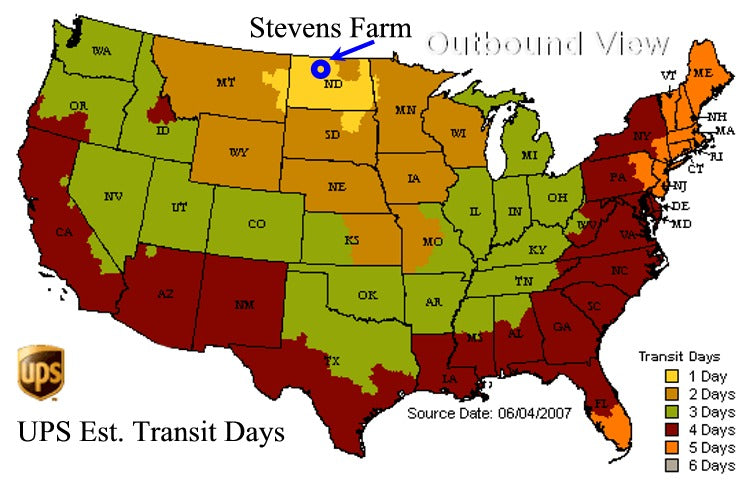
We are a family run operation. Most of the time your phone orders will be taken by one of our family members. When you place an order online using our shopping cart you can be assured that you are placing your order securely. Just look in your address bar and it should read https:// The S stands for a secure server. UPS Transit Map
Phone orders: 1-888-783-2545 toll free
All orders received by 11:00 AM will be shipped the same day.
We Ship UPS & US Postal Priority Mail
back to topAny Guarantee?
YES, Our 100% Satisfaction Guarantee makes it easy, convenient, and safe for you to shop with us 24 hours a day, seven days a week. We guarantee the finest quality, service, and security available online today.
YOUR COMPLETE SATISFACTION IS OUR GOAL!
We are proud of our record: Satisfied Customers 99.05% Return .95% (results from our accountant)
*Return Policy: The Buyer is responsible for all return shipping costs and may only return one opened package all other packages must have their original seal. A 10% restocking fee will be accessed plus original shipping charges we have incurred. It the buyers responsibility to provide a correct UPS shipping address. If you want your order shipped other than UPS please contact us prior to placing your order. UPS does not ship to PO Boxes or APO addresses. All our shipments are made in new boxes meeting our shippers standards. Any damaged merchandise during shipment must be settled with the shipping company.
We Ship UPS & US Postal Priority Mail
back to topDoes this Flaxseed work for Pillows?
Yes, our Flax Seed works great for the purpose of creating aromatheraphy products such as wraps and pillows. Our flaxseed is free of weed seeds and debris that may eventually work their way through the fabrics. Click here for Flax Seed for crafts and animal feed.
back to topI want more information. How do I get the answers?
Contact us at mstevens@srt.com All messages will be replied to within 24 hours.
Or call us at 1-888-783-2545 or 701-362-7331
Office Hours: 8:00am - 5:30pm CST, Mon-Sat


The information and statements made throughout this web site have not been endorsed/evaluated by the Food and Drug Administration or any other governmental authority, unless otherwise specifically noted.
Read Disclaimer
Copyright © 2026 Stevens Farm. Powered by Shopify. Design by Platypus Man.